Wednesday, August 3, 2011

The Ecologist


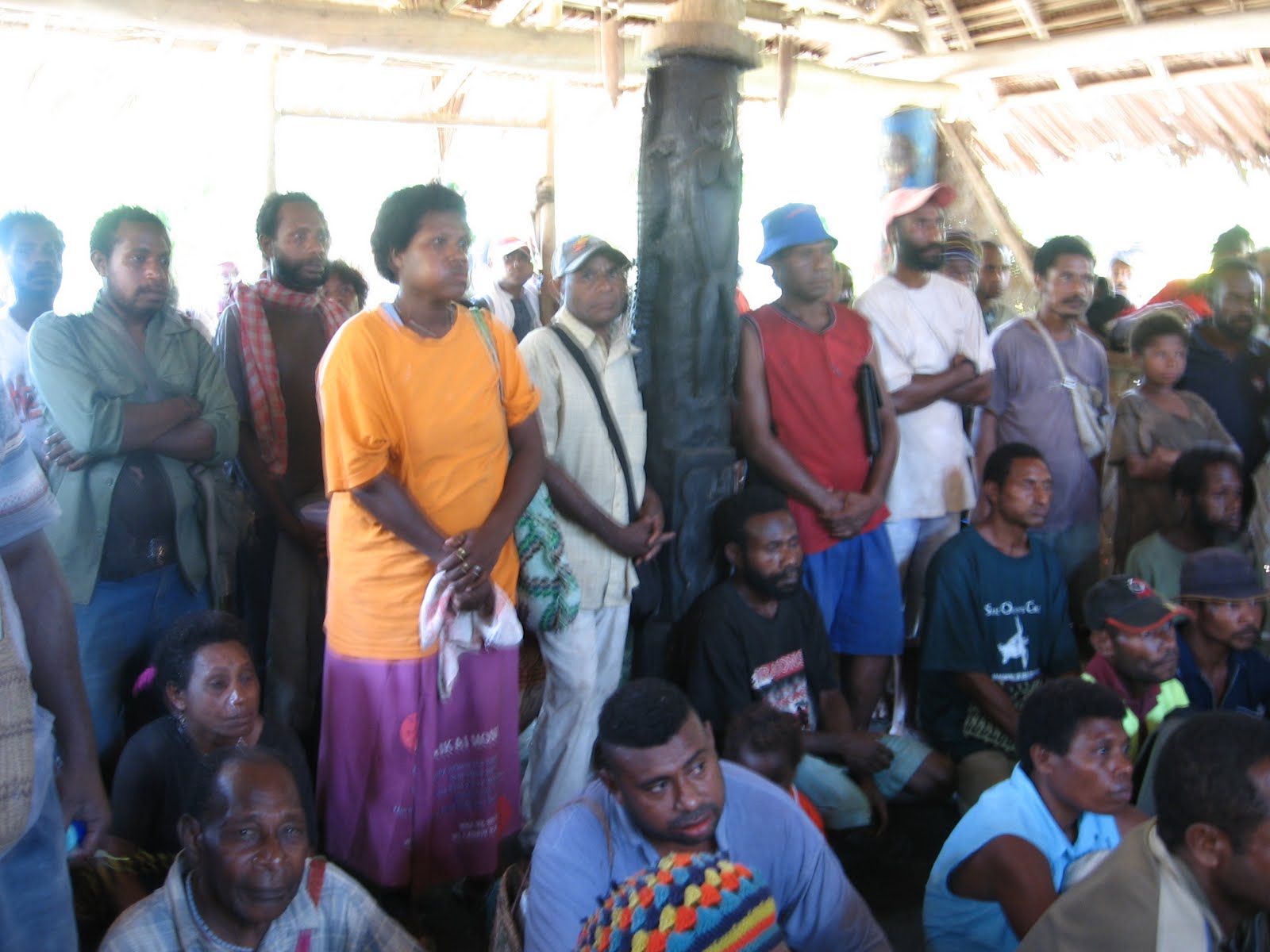
Some scientists believe deep-sea hydrothermal vents systems may be where life first evolved on earth (Image: Wenceslaus Magun's photos reveals the first Ramu MCC's and Highlands Pacific's deep sea tailings disposal and Nautilus' deep sea bed mining educational awareness conducted on Bagabag Island and at Tokain village, Madang PNG by Professor Richard Steiner, former Executive Director for the Minerals Policy Institute of Australia, Ms Techa and Indigenous New Caledonians (Kanakis.) These awarenesses were conducted a day after Nautilus sent in its deligation to Bagabag Island. 19th August 2007


28th October, 2010

As Papua New Guinea gives go-ahead to a Canadian mining company to dredge its coastal seabed for minerals, critics say environmental assessments have been inadequate, local objections ignored and new species of life could be extinct before they have even been discovered.

Deep-sea hydrothermal vents systems may be where life first evolved on earth

It was perhaps only a matter of time before mining the deep seas took off. Following in the footsteps of deep-sea fishing and drilling for oil it has been lurking in the minds of exploration companies like Nautilus Minerals, which is behind a major project in Papua New Guinea (PNG).

The idea of digging up the seabed one mile beneath the ocean surface to extract mineral-rich deposits such as copper and zinc first emerged in the 1960s. An initial flurry of interest in the 1970s was put off by low metal prices and UN regulations that exist on exploiting resources in international waters.

But with rising demand from China and India for rare earth metals like copper, and deep-sea surveys having now found concentrations of minerals four to five times those on land, it has returned but this time in the ‘unregulated’ territorial waters of PNG, conveniently close to the Asian markets. 


Ecologists say the PNG government is allowing Nautilus to go ahead with the first ever commercial deep-sea mining project without properly considering the environmental impacts or local opposition. Nautilus investors include the mining giant Anglo-American which is ignoring indigenous opposition to a gold and copper mine in Alaska.

‘Cradle of life on earth’

As well as being metal-rich, the volcanogenic hydrothermal deposits which Nautilus plans to mine are home to a unique ecosystem that is still largely unknown to scientists since being discovered in the late 1970s. Initially, the deep sea was thought to be full of soft sediment and little else but the discovery of hydrothermal vents on the seabed, which produce the deposits, revealed a completely novel ecosystem, unreliant on photosynthesis.

‘It’s the cradle of life on earth,’ explains Dr Rod Fujita from the Environmental Defense Fund and author of studies looking into deep-sea mining, ‘and the only one that does not depend on sunlight. There are species there that are found nowhere else on earth. It’s not like any land habitats we are used to; in fact you have to have your perspective altered to appreciate this deep-sea world,’ he says.

The mining process in PNG will take the top 20-30m off the seabed at a depth of 1,500m and lift it up to the surface before transferring it by barge to processing sites on land. ‘You will destroy fauna just by lifting the land,’ says deep-sea ecologist Professor Paul Tyler, from the National Oceanography Centre at Southampton University. ‘It is possible you might mine at a distance [from the hydrothermal vents] but by mining close by you will affect the flow and the vents might switch off and then all the animals die – you lose a huge biomass.’

'Flimsy' environmental report

Nautilus has attempted to fend off these criticisms by publishing an environment assessment, co-produced by a respected deep-sea biologist Dr Cindy Van Dover. In it they admit the impact to vents and seafloor habitats will ‘inevitably be severe at the site scale’ and that they will take ‘many years’ to recover. 

However, other ecologists say the assessment is ‘flimsy’ and fails to give a full account of the potential damage mining will cause.

Professor Richard Steiner, from the University of Alaska cites the incompleteness of classification of species found at the sites and an inadequate assessment of the risks associated with sediment and waste rock disposal. He also cites the effects of increased light and noise in the deep ocean environment and the toxicity of the dewatering plume [the process of removing water from the mined deposits] to deep-sea organisms, which will not be able to differentiate between food and junk sediment.

Of particular concern are the hundreds of thousands of tonnes of waste that will be produced by the mining process, which Steiner compares to that of a ‘giant underwater tractor’ and which will be pumped onto deeper seabeds nearby. Dr Fujita said the physics of water as well as weather and currents made it difficult to predict or contain any spill and that deep-sea mining had the capacity to produce pollution that could travel across into international waters.

A smoking hydrothermal vent on the ocean seabed

Exploitation or financial gain?

‘I don’t think the project would be allowed to proceed anywhere else in the world based on such a poor analysis of risks,’ says Steiner. The USA is known to have similar deposits off the coast of Washington as has Canada but mining is not thought to be imminent. Dr Fujita suggests Nautilus is just the latest overseas mining giant to take advantage of lax regulations in the country. ‘In PNG they have a poor record of mining on land resulting in lots of poor conditions and that bad record and lack of oversight is now moving from land to sea,’ he says.

Only this week the PNG government was accused by Greenpeace of allowing rampant logging and failing to respect the rights of indigenous groups who depend on the forests.

Nautilus has reportedly suggested the country would benefit by more than $200 million from the mining but Steiner says the benefits to local people or the economy of PNG were likely to be disproportionately low compared to the scale and risk of the project. ‘While the project could gross almost $1 billion USD in its 30-month lifetime, it expects to provide only $41 million in total taxes and royalties to the government, a $1.5 million development fund and a few dozen jobs at most to PNG nationals,’ he said.

Prof Steiner is also acting as a science advisor to Mas Kagin, a group formed in 2008to give a voice to coastal indigenous people in PNG oppose any commercial mining. The group says it depends on the coastal waters for their ‘livelihood, culture and way of life’ and has a right to oppose the seabed mining. In a campaign video community groups from two provinces expressed their fears.

‘When we first heard that Nautilus was going to mine the seabed using technology that had never been used anywhere else it felt as though we were becoming a science lab…and our very lives part of an experiment to test this new technology,’ it says.

Nautilus conducted workshops with local villages to explain its proposals but rejected calls to set up a permanent citizens advisory council. The company also declined to respond to concerns raised in this article but has previously said it took great pride in ‘leading the mining industry into the deep ocean’.

Opening the floodgates

It has estimated several billions tons of copper could be extracted from seafloor sites around the world. Dr Tyler acknowledges that the deep-sea has ‘not even had its surface scratched with what it might contribute to the economy’ but fears PNG’s decision to approve Nautilus mining plans will ‘open the floodgates’ before proper assessments have been made of the impact. China is known to be seeking to mine similar deposits in the South-West Indian Ocean.

‘Deep-sea fishing is a good example. We can ring alarm bells but there is no regulation of it. If I had my way the whole area of deep-sea would become a protected area and people who want to exploit it would have to apply to a body who can ensure that they were doing a proper environmental analysis before they were allowed to exploit it. At the moment there is no requirement at all and we end up looking at the damage done,’ he says.

Steiner agrees and says there is too much wrong with the PNG project: ‘the way this first deep-sea mine proceeds will set the tone for all others, and this is a very, very bad start’. He argues investment in reusing copper and gold made more sense than continuing to pay mining companies to take bigger risks in an effort to dig up more.

‘The global economy simply does not need the gold or copper that would be recovered at these deep-sea hydrothermal vents. We know how to recycle and reuse much of the copper already up out of the ground, run through the economy, and discarded in waste dumps. It is a unidirectional waste of resources, energy and money. And we know better.’

Sunday, July 24, 2011

Some services we can provide


Here are some of the basic services we can provide:

• Conduct Community Awareness
• Conduct Community Mapping and Needs Analysis
• Assist Groups To Develop Plans
• Facilitate Agreement
• Facilitate Implementation (Start-up) of Group Activity
• Monitor Community Activity
• Transfer Skills and Knowledge
• Evaluate Activity Outcomes
• Train Trainers
• Access Community Development Workers

Other technical skills can also be sourced from within our organisation and from technical experts to be engaged in meeting your needs.

Please do not hesitate to contact us on -

Mas Kagin Tapani
P.O. Box 1312
Port Moresby,
National Capital District
Papua New Guinea

Ph: + (675) 719 59665
Email: magun.wences@gmail.com

Our long-term goals


Our goal is to guide indigenous communities to go through a process to understand turtle conservation issue and to develop action plans to move forward.

Our efforts in Madang, PNG are laying the groundwork for the longer-term aim of empowering local communities to manage their own resources and be a strong voice for conservation in the region.

Our aim is to be the vehicle in sustaining the turtle conservation programs in PNG and in the Western Pacific region.

We also intend to provide a direct voice to a growing population of the indigenous people across the region who has shared concerns relevant to their customary connections to the Bismarck Solomon Seas.

It is our desire to extend our turtle conservation efforts to Rai coast, Bogia and to the outer islands of Madang Province to see an increase in the number of live and healthy hatchlings returning to sea. But in order to do that we must first prove successful in implementing this project in our current pilot project sites in north coast of Madang Province (See Project Map).

We also intend to extend our programs over to West New Britain, and Bougainville where leatherbacks come to nest as indicated by the aerial surveys map conducted by NOAA which we have obtained from TNC. And if funding is available we want to explore turtle protection and restoration initiatives through out the coastal areas in PNG.

We also believe that by involving all communities to participate in the protection and restoration of the leatherback turtles and other turtles can we benefit to understand the leatherback turtle population and other turtles trends in our region.

Our efforts in Madang complements past research and monitoring work at Kamiali and other Huon coast sites dating back to the mid 1980s.

We will also address all other related and relevant marine and community livelihood programs that complement the needs, aspirations, desires, visions and missions of all the indigenous inhabitants whom we work with.

Tuesday, June 28, 2011

Running a cab to protect turtles in Madang


By WENCESLAUS MAGUN

Arching against the seat of his green sedan cab with his eyes shifting occasionally from the daily newspaper he is reading, to search for a potential passenger, he waits in patience.

Throngs of people gather at the Hohola bus stop in their daily rush for transport to or from work, informal business ventures and other daily chores continue to swell in this bustling and booming city of rising new buildings.

He is not aware that amidst that crowd someone has spotted him. The unknown passenger is keen, curious and wondering why the driver is wasting his precious time behind those wheels.

Without doubt he also joins the ongoing list of many passersby who amongst other inquisitive thoughts wonder whether this cab driver is from the highlands region of Papua New Guinea (PNG) or not.

Dwelling on these thoughts he approaches the cab and to his surprise is greeted with warm welcoming gestures filled with joy from the cab driver: “Good morning bro, how are? Do you want a ride to work?”

“Yes please, can you drop me off at work? He replies with smiles splashing across his grim face as he takes a deep sigh of relief, wipes out some sweat trickling down his face after having his favorite betel nut (buai) and gets into the car. “I have been struggling to catch a bus to work. It’s getting late and I need to get to work quickly.”

As they drive off in this cozy Waves cab along the Poreporena free way on this glorious sunny morning on their way to the central business district of down town Port Moresby, he soon discovers that the driver is from Madang.

He also discovers that the driver is not only driving to make ends meet in these tough economic times to meet the demands for food and other basic needs of a town dweller. To his amazement he finds out that the driver drives to sustain his sea turtle restoration project in the north coast of Madang, in PNG as well.

The driver and owner of Waves Cab is the national coordinator of his newly established organization called Mas Kagin Tapani Association or Makata. After his contract ended with the Turtle Island Restoration Network (TIRN) a US-based non-government organization in 2009, as their Western Pacific Campaigner for the Sea Turtle Restoration Project (STRP), he established Makata to sustain this program.

With support from TIRN he managed to incorporate this entity and continue to float the organization. The successful implementation of this project is feasible also through funds raised from Waves Cab services, funds from potential donors including WWF-Western Melanesia, Global Greengrants Funds (GGF), and South Pacific Regional Environment Program (SPREP) and with in-kind support from his family members.

“We would also like to extend our gratitude to Raymond Palangat and staff of World Bank in Port Moresby and to the family and friends of Cathy Edmunds at the Port Moresby International School for the donation of library books which we have donated to schools, communities and churches both within our project sites and in Port Moresby. Special thanks goes also to all the media organizations for promoting this campaign both in PNG and abroad,” he informs his companion.

He pointed out that this project aims to protect and restore the population of the threatened and critically endangered sea turtles including the leatherback turtles or Dermochelys coriacea in the Western Pacific region. To achieve this goal we are working closely with coastal communities in Madang Province, whose beaches these turtles come to nest.

The driver elaborated that this effort complements PNG Government’s initiative to protect and restore the population of the critically endangered turtle species in the region. It also reflects the commitment between the tri-nations (Indonesia, PNG and the Solomon Islands) to achieve this outcome in the region.

“We endeavor to raise awareness about the role and importance of marine turtles in ocean and coastal ecosystems; the numerous natural and man-made threats to these species, many of which are threatened or endangered; and the ways in which individuals, communities, and governments can work together on a range of conservation and recovery activities.”

He continues: “Sea turtles of today have changed little from their ancient reptilian ancestors that appeared on earth millions of years ago before humans. For many years, humans have been exploiting turtles for food and decorative ornaments. In the last 200 years or so, the uncontrollable harvests of adults and juveniles and turtle eggs have caused sea turtle population worldwide to drastically decline. The remaining population is critically endangered and very close to extinction.”

“Is that true? Oh how sad! And how many turtle species live in our ocean?” The curious companion asks.

“Of the seven of world’s marine turtles, six occur in the PNG marine waters. These include the flatback, the green turtle, the hawskbill, leatherback, the loggerhead and olive ridley. Of these six, hawsbill, green turtle and leatherback turtle are most common. From previous survey results and anecdotal information, PNG has some of the largest remaining populations of hawksbill, green turtle and leatherback turtle in the world today. However, these populations and especially the leatherback turtle have rapidly declined,” the driver emphasized.

He highlighted that marine turtles have lived over 100 millions of years. They grow slowly and take between 30-50 years to reach sexual maturity. Some live to be over a 100 years old.

Sadly, all marine turtle species are experiencing serious threats to their survival. The main threats are:
• Pollution which can cause change to the environment – especially reefs and nesting areas;
• Marine turtles are also killed by entanglement in marine debris;
• Incidental catch in active fishing gear;
• Predation by feral animals; changes to habitat; and
• Food sources and indigenous hunting.

As they reached the peak of the Poreperena freeway, the driver points out to the sea over the horizon and reminds his companion:

“Marine turtles migrate long distances of up to 3000 km or between 6,000 miles nesting beaches and home foraging grounds so that impact on animals in one region has far-reaching implications for populations that spun local, regional and national boundaries.”

The driver stressed also that marine turtles have traditionally had strong cultural linkages to local communities along the coastal areas of PNG. To maintain these cultures drastic decline in turtle populations must be able to be put to a stop.

“Many beaches and near shore reefs along the coastal areas of PNG are home to the marine turtles. While turtle conservation programs have been initiated in a few parts of PNG, large areas although significant in nature lack turtle conservation programs. It is in these areas that local consumption of turtle for eggs and meat goes on without saving some of these turtles and eggs.”

“Since establishing this project in 2006 we have enabled Karkum villagers to establish their Locally Managed Marine Areas (LMMAs) using Conservation Deeds (CDs). We hope to continue this process with other coastal communities in our current project sites. Our effort has transformed the mindset of a people that once habitually killed leatherbacks and harvested their eggs for consumption,” he continues.

The group endeavors to empower these communities to develop their own management strategies and to develop and implement conservation initiatives to maximize hatchling production and on-shore survival.

The driver believes that with adequate training these communities will nurture a long-term conservation ethic and will promote turtle conservation efforts in the region.

Project location:

He said their project site is located on the northwest coast of Madang about 70 to 100 kms from Madang town in PNG. This project involves the communities of Karkum, Mirap, Tokain 1 (Yadigam), Tokain 2, Magubem, and Kimadi comprising of more than 3,000 people. Although this location does not boast of having the highest number of leatherback turtles frequenting its beaches when the project was first established compared to the Huon coast project in the Morobe Province, PNG covering the villages of Paiawa, Kamiali, Buli and Labu Tale, it remains to be the first model site for establishing a turtle conservation project using a locally managed marine area (LMMA) using conservation deed (CD).

Project Description

“Our project may not be the largest and “sexiest” compared to the Huon coast, in Lae Morobe Province, PNG, but we have made an impact in that we have transformed the mindset of a people that once habitually killed leatherbacks and harvested their eggs for consumption.”

“These communities have appreciated the values of the species and are now protecting and restoring them. But that is still not sufficient. We know that more needs to be done if we are to achieve an overriding objective of this project in determining the nesting population size and developing management strategies for each of the communities engaged in this project,” he stressed.

“It is our desire to review the first turtle training workshop we had initiated on the management strategies concept in which we had encouraged participants to identify issues and solutions to these issues and assist them develop their management plans with an ultimate aim of building their capacity to sustain this program,” he reiterated.

In addition, he pointed out that the turtle training aims to train beach rangers from these communities to develop and implement conservation initiatives to maximize hatchling production and on-shore survival.

“With adequate training we are optimistic the communities will nurture a long-term conservation ethic and will become role models in sharing and working with other communities to promote turtle conservation efforts in the region,” he said.

“We also want to complete the process of establishing LMMAs using CDs in Kimadi, Magubem, Tokain, Yadigam and Mirap where our current project site is located by the end of 2012 or in the coming years.”

The story had captivated his companion so much so that he did not realize that they had reached his point of hire. Leaving the car he thanked the driver as he hands over a K20.00 and requests for more information.

To the driver’s companion and to those who want to learn more about our turtle’s conservation initiative please log onto: maskagintapani.blogspot.com or view a Short movie about our project by Scott Waide: http://www.youtube.com/watch?v=CeHRRyDe1LA

Other Outstanding Accomplishments

Other outstanding achievements included a paper he presented to an international audience at the Griffith University on the 29th International Sea Turtle Symposium in Brisbane, Australia from the 17 to 19 of February 2009. In his talk he promoted the Conservation Deed Approach of establishing marine protected areas to protect and restore the turtle’s population in the Western Pacific region.

He also presented a paper to participants at a meeting organized by CSIRO (Australia) at the Moreton Bay Research Station, Queensland-Australia from the 17th to 19th of June 2009. His report titled: “Can direct conservation payments promote environmental conservation and livelihood enhancement in selected sites/circumstances?” This talk aimed at finding a way forward to achieving the Eight Millennium Development Goals through direct conservation payments to communities who promote environmental conservation outcomes.

Donations to support this effort can be deposited into:
Mas Kagin Tapani Association (Bank of South Pacific Waigani Branch) Cheque Account Number: 1001546953. Its SWIFT Code is BOSPPGPM. Internal Revenue Commission’s Tax File Number is: TC 8662
Inquiries
For further information please
Contact:
Mr. Wenceslaus Magun on:
Ph: + (675)719 59665 or
Email: magun.wences@gmail.com.
Address:
P.O. Box 1312, Port
Moresby, National Capital District,
Papua New Guinea.

Monday, June 27, 2011

View A Short Movie About Our Project


Since the establishment of Makata, the organization has benefitted from WWF-Western Melanesia’s funding, Global Greengrants Funding (GGF), South Pacific Regional Environment Program’s (SPREP) funding and long-term commitment to support this project as indicated in their media statement(http://www.sprep.org/article/news_detail.asp?id=831.

With funding support from SPREP, Scott Waide from the Bismarck Ramu Group managed to produce this short movie. Please join us in viewing our movie on http://www.youtube.com/watch?v=CeHRRyDe1LA

Go to my profile to view this movie at your convenience!

Thursday, June 9, 2011

What Is Conservation Deed?


What is a Conservation Deed?

It is a product of a community-driven process that results in increased community awareness, education, and training. It is a formal legal document from the community that creates a locally managed conservation area and a long-term community stake in the protection of natural resources in ways that also meet the economic and social needs of the community. Robert H. Horwich in A Landowner's Handbook of Relevant Environmental Law in Papua New Guinea states that "The Conservation Deed is a recent innovation which might be considered something like a 'People's Conservation Area.'…[S]ome lawyers feel it may be the strongest kind of legal land protection…"

Our campaigns highlight the root causes of environmental destruction, which often begin with lack of community control over resources and the inequitable distribution of power. We see the plight of these species not only as single species environmental tragedies that need immediate attention, but as a vehicle for shifting the paradigm of how the human species views its relationships with the natural world.

Our goal is to guide resource owners through a process to understand this issue and to develop action plans to move forward.

Our efforts in these communities in PNG are laying the groundwork for the longer-term aim of empowering local communities to manage their own resources and be a strong voice for conservation in the region.

Karkum Villagers Use Bamboo Grids To Protect Turtle Nests


Sea turtles of today have changed little from their ancient reptilian ancestors that appeared on earth millions of years ago before humans. For many years, humans have been exploiting turtles for food and decorative ornaments. In the last 200 years or so, the uncontrollable harvests of adults and juveniles and turtle eggs have caused sea turtle population worldwide to drastically decline. The remaining population is critically endangered and very close to extinction.

Of the seven of world’s marine turtles, six occur in the PNG marine waters. These include the flatback, the green turtle, the hawskbill, leatherback, the loggerhead and olive ridley. Of these six, hawsbill, green turtle and leatherback turtle are most common. From previous survey results and anecdotal information, PNG has some of the largest remaining populations of hawksbill, green turtle and leatherback turtle in the world today. However, these populations and especially the leatherback turtle have rapidly declined,” the driver emphasized.

Marine turtles have lived over 100 millions of years. They grow slowly and take between 30-50 years to reach sexual maturity. Some live to be over a 100 years old.

Sadly, all marine turtle species are experiencing serious threats to their survival. The main threats are:
•Pollution which can cause change to the environment – especially reefs and nesting areas;
•Marine turtles are also killed by entanglement in marine debris;
•Incidental catch in active fishing gear;
•Predation by feral animals, changes to habitat; and
•Food sources and indigenous hunting.

Marine turtles have traditionally had strong cultural linkages to local communities along the coastal areas of PNG. To maintain these cultures drastic decline in turtle populations must be able to be put to a stop.

Many beaches and near shore reefs along the coastal areas of PNG are home to the marine turtles. While turtle conservation programs have been initiated in a few parts of PNG, large areas although significant in nature lack turtle conservation programs. It is in these areas that local consumption of turtle for eggs and meat goes on without saving some of these turtles and eggs.