Sunday, October 30, 2011

MAKATA funds GILDIPASI Community Banking Project

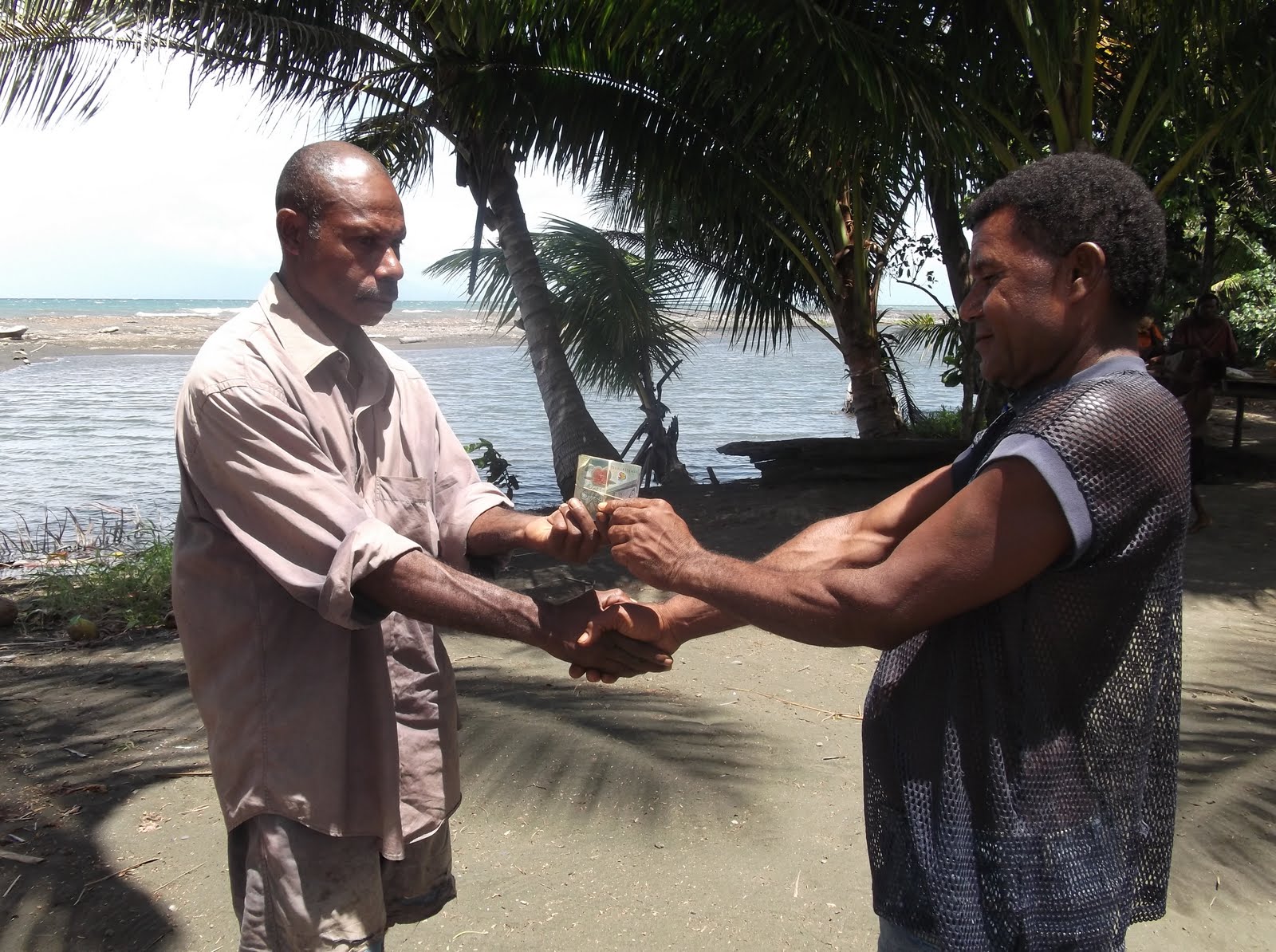
MAKATA's Chairman, Mr. Yat Paol donating K5,000.00 as direct conservation incentive fund to GILDIPASI President, Mr. Peter Bunam to kick start the community banking initiative. Photo: Wenceslaus Magun

By WENCESLAUS MAGUN

Kangate beach at the mouth of Gabe River in Tokain some 100 kilometres northwest from Madang town may not mean much to anyone, even to the locals. Yet it marks the centre for the establishment of a community village banking initiative for the people of the GILDIPASI region.
On Saturday 22nd of October 2011, at 12:48pm Mr. Yat Paol chairman of Mas Kagin Tapani Association (MAKATA) a local not-for-profit group, presented K5,000.00 to Mr. Peter Bunam, chairman of GILDIPASI Planning Committee at this beach front. The money is a direct conservation incentive to propel sea turtle conservation efforts in the GILDIPASI region.
The GILDIPASI region consists of villages from Yadigam, Tokain, Malas, Magubem, Dibor , Simbukanam and the surrounding inland villages comprising of more than 3,000 people.
Speaking on behalf of the GILDIPASI people, Mr. Bunam expressed deep appreciation and acknowledgement to the funder, Santa Monica Seafood and FishWise and MAKATA for making this dream a reality.
“I lost heart in running the affairs of GILDIPASI due to lack of cooperation from key members. But today, marks the beginning of a new era. It has boosted my moral and motivated and inspired me to rise up from my slumber and lead my people to achieve our vision and mission,” Mr. Bunam said.
He assured Mr. Yat that the funds will not be used immediately but after a proper training on village banking is implemented. Responsible, reliable, honest and accountable people will also be appointed to manage this fund.
“We will bring in specialised trainers from the Lutheran Church Development Services to conduct a training on their concept of “Putim (Invest), Kisim (Withdraw) na Mekim (Use) before we start using the fund,” Mr. Bunam stressed.
He emphasised that in order for the community to take ownership of this project, they will be urged to invest in this fund as a prerequisite to seeking loan for their micro-enterprise projects.
In addition, Mr Yat assured Santa Monica Seafood and WiseFish that as a resource owner from Tokain village he will ensure that proper procedures, bi-laws, and policies are established by GILDIPASI to manage this fund. The official signing of the Memorandum of Understanding between MAKATA and GILDIPASI will be on the 30th of October in the midst of all the community members.
Other key spokesmen and community leaders from GILDIPASI, Mr. Sim Bunam, Mr. Ernest Gidaget, Mr. Joseph Mukup, Mr. Alfred Kaket and Mr. John Natu assured the national coordinator for MAKATA Mr. Wenceslaus Magun that this gesture has challenged them to speed up the process of establishing their coastal management marine area (CMMA).
The sea turtle restoration and protection project was established in mid 2006 by Mr. Magun when he was contracted by Turtle Island Restoration Network (TIRN) a 501c3 non-profit organisation in US as their Western Pacific Campaigner. By December 2009, TIRN ceased funding this project but has supported its sustainability with the initial funding for its establishment.
This project has seen Karkum village established its CMMA on 17th of November 2008 when they signed their conservation deed. With support from their DUARGO community based organisation they have since conducted independent and voluntary beach monitoring exercise. Data collected have been supplied to the South Pacific Regional Environment Program (SPREP) since 2010.
Their efforts has seen a gradual increase in the number of leatherback turtles being protected along their grey sandy beach nesting sites and their hatchlings safely returning to sea.
Of the seven turtle species, leatherback turtle (Dermochelys coriacea) is identified on International Union for Conservation Network’s (IUCN) Red List as critically endangered. They are the largest living turtles that survived the dinosaur era. They can grow to 2 meters, weigh more than 300 kilograms, dive the deepest and swim for 6,000 miles from California to feed and return to PNG to nest. Sadly they are habitually being killed for protein in these communities and from accidental bi-catch from industrial fishing, pollution, climate change effects, poaches, and feral animals.
According to Mr. Magun, much more can be achieved to sustain this project if communities are trained and motivated to nurture environmental ethics grounded in Christian principals, modern scientific knowledge and appreciated with traditional cultural heritage and linkages.
“We strive to assist communities develop and manage their own management strategies and implement conservation initiatives to maximized hatchling production and on-shore survival,” Mr. Magun reiterated.
Key funders for this project include:
• Turtle Island Restoration Network;
• WWF-Western Melanesia;
• Global Greengrants;
• South Pacific Regional Environment Program;
• The World Bank-PNG;
• Santa Monica Seafood and FishWise;
• Cathy Edmunds; and
• Waves Cab services.
MAKATA’s mission is to support local communities to protect and restore the declining leatherback turtle’s population and strive to restore and protect the health and safety of the marine resources and its indigenous people as their voice and link in the Bismarck Solomon Seas.

Thursday, October 6, 2011

Land Management ....A big hurdle for REDD


By Dennis Badi

A new NRI report, released today has highlighted land management as the biggest hurdle for the Government if REDD was to become a viable development option in the country.

The implementation of REDD and carbon trade in PNG will not be an easy task for the government due to the country’s complex land tenure systems states the report.
Reducing Emissions from Deforestation and Degradation of forests or REDD is an international initiative for mitigating the adverse effects of global warming and climate change by placing a commercial value on carbon storage in natural forests.

The report states that the Government of PNG has already committed the country to a National REDD Scheme at the international level and this requires most of PNG’s customary land and forests to be mobilised under the program.

However the mechanisms which land can be mobilised and REDD can be effectively implemented in PNG are not yet in place says the report.

Author, Mr Nalau Bingeding discussed that in the REDD plan PNG will need much of the 33 million hectares of forested land, which is customarily owned. Hence the government will need to find effective ways to implement REDD on customary land, so that conflicts of interest among customary landowners and competition between developmental sectors for forested land for development are kept to a minimum.

Mr Bingeding states that the country requires a National Land Use Plan in order for REDD and carbon trade to be effectively implemented in PNG. This plan would ensure that possible risks to REDD projects are avoided in the initial stages of development and that there are no disruptions to REDD projects in the long-term.

Mr. Bingeding also explains that the government must consider creating a National REDD Baseline and Climate Change Secretariat to manage REDD and other climate change issues.

(Our National Coordinator Mr. Wenceslaus Magun was invited to attend the launching of this book on the 5/10/2011. It was another golden opportunity for us to network with new partners and also to share our stories with them)

Leatherback Sea Turtle Conservation Efforts Receive RSVP Funds


Posted by Santa Monica Admin, on August 23rd, 2011 in Announcements

Santa Monica Seafood is proud to announce RSVP support for Makata, a community based conservation organization working towards the conservation of endangered leatherback sea turtles!
Leatherback sea turtles are the largest of the world’s sea turtle species and are listed as critically endangered on the World Conservation Union’s (IUCN) red list. The Pacific leatherback population that we find in our local waters breed in Papua New Guinea and Indonesia, making an amazing 13,000 mile journey across the Pacific Ocean to feed on the jellyfish that are rich in the California Current. Due to their unique migratory patterns and life history, pacific leatherback sea turtles face many threats including illegal poaching of eggs on nesting beaches, coastal pollution, ingestion of plastics, entanglement in abandoned fishing gear, nesting beach habitat destruction and incidental take in pelagic fishing gear. In the last 25 years, Pacific leatherback sea turtle populations have declined as much as 80-90%.
Makata, whose name means “Sea Guardian” in the local Bel or Takia languages of Madang, works with coastal and indigenous island communities in Papua New Guinea to restore and protect these critically endangered leatherback turtles. Their efforts involve protecting nesting beaches and marine waters to maximize hatchling production, facilitating educational awareness programs, media campaigns, resource mapping and boundary surveys. They have also implemented a tagging and monitoring project within their local communities.
Santa Monica Seafood’s RSVP program has a unique opportunity to protect the future of our local leatherback sea turtle population by supporting Makata’s conservation efforts on leatherback nesting beaches across the Pacific in Papua New Guinea. We are very excited to be supporting the efforts of Makata and the conservation of one the oceans oldest, and now most imperiled, species.
To follow Makata’s efforts to protect the leatherback sea turtle please visit their blog or watch a video about the project!

Saturday, September 17, 2011

Social Mapping and Baseline Study for Mur and Sel villages in Rai Coast district, Madang province, Papua New Guinea


By Leeray Letani Robin, Pita Gabu, Cabrinie Gatagot and Wenceslaus Magun

Date: 21st June 2009

Community Location

Part A – Mur Village – Ward 5, Saidor Local Level Government

Part B – Sel Village – Ward 3, Saidor Local Level Government

Content

1. Introduction
2. Activity

2. a – Mur community Report and Recommendation
2. b – Sel community Report and Recommendation

Introduction

Mur and Sel villages are about three to four hours by speed boat and are situated in East of Madang town in the Rai Coast District of Madang Province in Papua New Guinea.

Our team comprised of Peter Gabu, Cabrinie Gatagot and Leeray Robin. This was the first team’s visit into the two communities and team was asked to do Social Mapping and Baseline study for the leatherback turtles nesting beach project. The team understood that this community entry was the phase one of their overall strategy to achieve Makata’s project objective which is to establish locally managed marine protected area using conservation deeds.

The purpose of this trip was mainly to establish a relationship with the community, gain and maintain trust between each other and gather useful information about the community. The team was therefore conscious of their role as facilitators in ensuring that this first step is conducted diligently.

All the information collected in the two communities we visited, Mur and Sel were from the formal and informal meetings with the leaders and members of the communities by listening and questioning through story telling. The team did not carry out any interview and collect personnel information because they felt that this might raise expectations in the community.


Background

Rai Coast District is politically volatile and administratively challenging and exciting.

It consists of four (4) Local Level Government’s (LLG), ninety- six (96) wards and one hundred and ninety four (194) - census units. Respectively, the LLG’s are, Saidor, Astrolabe Bay, Naho-Rawa and recently proposed Nayudo.

The government provides basic services in education, health, law and order, transport and infrastructure and economic. The network of the services can be determined by assessing the number of government facilities and establishments in the communities that is, wards or LLG of the districts.

Rai Coast represents about 15% of the total population in the province. The estimated population of the district is about 56,300. The total Land Area for the district is 6,573 square kilometres (Km2). This distribution according to LLG area are as follows; Saidor LLG 2,979Km2, Astrolabe Bay with 1,710 Km2, Naho-Rawa with 1,220Km2 and proposed Nayudo with 664 Km2.

People on the Rai Coast require around four hours’ travel to reach Madang town, while those in the Finisterre range require up to eight hours’ travel. During the wet season, travel times from the Rai Coast to Madang rise significantly because of flooded unbridged rivers. Long Island is 70 km from Saidor and 130 km from Madang. It is the most remote part of the District as small boat travel is expensive and dangerous from December to March. People on Finisterre range are very remote and must walk to roads on the Rai Coast and in the Ramu Valley.

Access To Services

The lack of accessibility to government centres is exhibited in its poor infrastructure development. The district headquarter is located in Saidor and is accessible by air and sea from its three Local Level Government Centres namely Tauta for Nahu-Rawa; Ileg for Astrolabe Bay and Teptep for Nayudo. Saidor is in Rai Coast LLG and is the District Headquarter.

There is limited communication between the Local Level Governments and the District Headquarter because the road system, which links all its LLGs, is not in a good condition. Extension Officers from Tauta in Nahu-Rawa, travel by road to Walium, in Usino-Bundi District, then to Madang before arriving at Saidor in Rai Coast, either by air or sea. Therefore, due to these difficulties, the three modes of transport will have to be used.

The Madang/Saidor road, despite being a national road has been neglected over the past fifteen to twenty years. The road requires major upgrading, construction and sealing. Many major bridges have to be constructed over more than sixty-two (62) rivers before the road can provide any useful service to the people of Rai Coast District.


Patrol Schedule

Mur Village

Tuesday 2nd June 2009 – Team left Madang town and arrived in Mur village on a speed boat
Wednesday 3rd June – Team conducted village assessment and collected information
Thursday 4th to Sunday 7th – Team conducted one on one assessments and data collection
Monday 8th June – Team met with the rest of the community, thanked them and left in the afternoon for Sel Community

Sel Village

Monday 8th June – Team left Mur and walked to Sel village
Tuesday 9th to Wednesday 10th June – Team did community assessment one on one
Thursday 11th June – Team met with the leaders to gauge their views
Friday 12th of June – Team met with the rest of the communities to gauge their views
Saturday 13th to Sunday 14th June – Team conducted one on one community assessment
Monday 15th June – Team left Sel village and traveled on a speed boat to Madang town.

Debrief - Summary

The team met with Wenceslaus Magun on Tuesday June 23 for debriefing. The team indicated that leatherback turtles had in May and June nested along Mur beaches. (See Photo of a recent nesting site attached). Mur folklore indicates that one of their clans originated from the leatherback turtles (Attached see Tilom’s Story). This particular clan had traditional been leatherback callers. They would kill leatherbacks and exchange their meat for other food stuff with inland villages. There were no nesting sites in Sel as the tidal waves had destroyed their nesting beaches. Traditionally, Sel villages harvested leatherback turtles eggs. They did not kill leatherbacks as they did not like its fowl smell. Mur and Sel villagers informed the team that they were waiting anxiously for this project to start following a reconnaissance and awareness visit conducted by Howard from Bismarck Ramu Group and Wenceslaus in 2007. The team recommended that a follow-up patrol is needed to collect all other necessary information as well as to conduct a leadership training. The team also agreed that they will do this follow-up patrol in August 2009. In the meantime, Gabu and Cabrinie have agreed to conduct further research on related social mapping issues using relevant sources with the provincial, district resources and universities and all other available sources in Madang.

2a – Mur Community

The team met with the community leaders on Thursday 4th of June 2009. The meeting started at 4:30pm and ended at 5:30pm. In this meeting, the team introduced themselves, Mas Kagin Tapani (Makata) Association’s objectives and explained about the purpose of their visit. The team sought permission to stay and work with them. The four leaders they met with agreed and supported Makata’s objective. The Ward Member, Mr. Albert Dawiyai granted the team permission to work with his community. The leaders asked the team to meet again with the rest of the community on Monday to brief them again of what they had just discussed with the leaders.

Data Collected from Friday 5th June to Sunday 6th June

Ward 5 is made up of six communities: Mur, Somek, Kasu, Yasel and Nom plantation, with a total population of 1,334 people.

Mur is made up of one big village and several hamlets. They have seven major clans. Here are the clans and the number of people in each clan.

Clans and Population

1. Marasok – M = 136 –F= 109 – Total = 245
2. Maigomba - M = 72 – F=50 – Total = 122
3. Yakot - M = 69 – F= 42 – Total = 111
4. Kamdau - M = 72 – F = 26 – Total = 98
5. Sokila - M = 58 – F = 22 – Total = 80
6. Mur - M = 115 – F = 64 = Total = 179
7. Dawang - M = 112 – F = 56 = Total = 168

The population is: Male 634; Female 369; Total = 1003
(NB: The team needs to identify clans that own the beach were the turtles come to nest in the next patrol).

Language

Apart from the main language of the community there are three other different languages spoken by the clans. One is slowly dying out. (NB: The team needs to collect the names of the languages in the next patrol).

Government Leaders

Ward Councilor: Albert Dawiyai
Committee: Balthy Mator
Village Recorder: Kaimalang Dabaliga
Magistrate: Tom Ambalis
Village Court Clerk: Mandor Kwang
Peace Officer: Alfred Ningau
Ward Development Committee: Caspar Matela
Land Mediator: Noki Fola

Church Leaders

Lutheran: Bill Dabaliga
Catholic: Caspar Matela
Lutheran Mama Group: Lini Tilom

Basic Services

The nearest health center, primary school and other government service is at Saidor, the district headquarters, some two hours walk away from Mur. The only service in the community is the elementary school.

Health Center

Saidor Health Center

School

Saidor Primary School; Parui Primary School; and Kavi Elementary School

Business

Nom plantation is a few minutes walk from Mur and is runned by Benny Leahy. There is a retail store and a wholesale there where people get their store goods. The company also buys copra and wet bean cocoa from the people.


Partner Institutions

Apart from the health clinic team and the Catholic priest’s visits, Volunteer Service Organisation (VSO) under its Tokaut AIDS Programme is supporting the Kunai Paia Theater group from the area to carry out awareness of HIV/AIDS.

The Healthy Island concept is introduced in the area by World Vision/Divine Word University.
The Lutheran Development Service (LDS) is also working in the area on water supply and micro finance.

Primary Means of Transport

The nearest airstrip is at Saidor but most people cannot afford to meet the airfares. The most possible transport is by boat and dinghy. Their most frequent mode of transport is by walking.

Source of Income

The main source of income is cocoa and copra. Another source of income is by selling local crops at the market, like bettle nut (buai), mastard (daka), lime (kambang), peanut, greens, garden produce, fish etc at the local markets. Mr. Tilom Dabaliga also produces and sells organic stock feed, a skill he learnt from the agriculture officers based at Rai Coast District.

Other Information

Folklore:

(NB: The Team needs to collect the folklore on leatherback turtle and how it relates to Dawang clan in Mur village.

Mens House:

Mur villagers had Mens Houses in the past. They still have sacred sites.

They don’t sell turtle meat and eggs. Traditionally they killed turtles mainly to trade with the inland people for taro. Even today they still don’t sell them. They use it for their own consumption.

Mur villagers still practice traditional methodologies of achieving conservation outcomes. (NB: The Team needs to identify them in the next patrol)

On Monday 8th of June 2009, the team met with the community. A total of 35 people attended the meeting of which 15 were women. Mr. Gabu led the discussion by introducing the team, Makata’s objectives and further explained that this visit was a follow-up of the awareness done by Wence and Howard back in 2007. Mr. Robin stressed the purpose of their visit and told them that they were there to know more about their community and that they wanted to hear from them a lot. The team also explained that this visit was very important as it will prepare them and prepare the team for the training workshop in the next patrol should there be any. Cabrinie added by asking two key survey questions: What they were happy about and What they fear about most at this time.

Happiness, Fear and Worry

What they are happy about is that their land and sea which provides everything they need. They are also happy about their customs and culture and their life in the village.

What they fear is their land. They don’t want the government to take their land rights away from them. They feel that they are part of their land and fear of losing that connection.

What they are worried about is the destructions that the mining companies will cause on the environment and the population of their resources both on land and sea.

The meeting started at 11:30am and finished at 1:00pm.

Community Assessment

Mur villagers and their leaders are very co-operative. The community is well organized and highly motivated to work with Makata in conserving their marine resources.

Team Assessment

Despite the time period being too short, the team managed to collect most of the necessary information needed. Teamwork is very good.

Feedback

Mur villages have welcomed Makata to continue its work with them. They are happy with the objectives of Makata.

Recommendation

After the assessment, the team recommended that Makata will continue with Phase Two of the process which is Community Development Training – Part One: PNG Pre-History Timeline in the next visit.


PART TWO

2a – Sel Community


Sel river one of many clear, clean, crystal and rapid streams. A good source for hydro power. Photo: Leeray Robin


The team met with the leaders on Thursday 11th June 2009, from 11.30am -3.30pm at the main meeting area. Sixteen Community leaders attended the meeting including the ward member Eddie Tasi.

After each team member introduced themselves, they took turn to introduce Makata and its objective. They further explained their reason for being in the community.

The leaders seemed satisfied with the introduction and explanation and allowed the team to stay and work with them. The team told them that they were going to stay for a week and gave an open invitation to anyone including the leaders to go and talk to them anytime whilst they were there.

The leaders arranged another meeting with the community on Friday 12th June 2009. This meeting started at 1.00pm and ended at 4.30pm with a total of 27 people of whom six were female. Every thing from the introduction down was the same as what they did in the first meeting they had held with the leaders.

Background

Ward 3 is made up to three villages; Seure, Sel and Baru. The total population is 1009.
Sel is made up of one main village and several hamletls. The total number of people is 506.

They have five major clans and they are:
a) Dagarup – Sub Clan: 1) Pengum; 2) Katibui; 3) Murubel; 4) Gung Gung Sa
b) Satmang,
c) Manbol,
d) Erek and
e) Deganang

Erek, Dagarup and Satmang clans own the land along the sea shore

Ereck’s Clan Leader – Mathew Abata
Dagarub Sub Clan Leaders (Pengum) – Dages Erro and (Katibui) – Parima Erro)


Government Leaders:

Ward member : Eddie Tasi
Committee: Sakaria Siga
Recorder: Farimak Siga
Ward Dev.Committee : Lutu Yatiyaring
Magistrate: Andipas Jolly
Land Mediator : Siga (Deceased)

Church Leaders:

Lutheran Church: Sake Dabung
Seventh Day Adventist: Luke Lingut
Christ for the Nation: Yaren Levi

Existing Groups

After the leatherback awareness was done by Howard and Wence back in 2007, Sel villagers had appointed some community members to take lead in the project. Here are the names and title of those appointed:

Peter Semen: Coordinator
Mathias Alak: Treasurer
Luke Lingut: Secretary
Malcholm Arnam: Chairman

They have Lutheran, Four Square, Christ For The Nation and Catholic Church. Apart from the clan, church and sports groups there are no other organized groups.

Basic Services

Education

There is an Parui Elementary School and Parui Primary School at Sel. These are government agency schools.

Health

The nearest aid post is at Seure, some 30 minutes walk and its run by the Lutheran Health Services. There is a good road linking Sel to Saidor, where all the government services are and its three hours walk from Sel.

Micro-Finance

Lutheran Development Services (LDS) is working in the area doing water supply for the aid post and introducing the micro finance scheme in community under the name “ Putim Na Kisim”.

NGO’s & CBO’s

VSO, under the “Tokaut Aids” supported a local theatre group from the area to do awareness about HIV/AIDS. The Bismarck Ramu Group is also doing its land and mining awareness campaign in the area

Primary Means of Transport

Most people prefer sea transport. The most reliable means of transport is speed boat, but they can travel by plane from Saidor District, or ride on bicycle

Main Source of Income

Cocoa and copra is the main source of income. Another source of income is by selling betel nut (buai), mustard (daka), lime (kambang), peanuts and other local crops at the market as well as fish.

Other Information

Land

Land issue is very sensitive in the community as there are disputes between major clans and sub- clans; thus, the people hesitated to give the names of sub-clans.

Hausman

They used to have sacred mens house (haus Tambaran). Today they practice the initiation in the clan and family groups in fear of sorcery. This new system use modern drugs to heal sore.

Turtle Meat and Eggs

Traditionally, they traded the turtle meat with the inland people for taro. They don’t sell the meat, even today people don’t eat turtle meat because of the unpleasant smell, but they do eat the eggs.

Folklore (Tumbuna) Story

Once upon a time in the village of Sel, they lived a clan group called Dagarup. They settled in a small hamlet at the end of Mt Tinigai, facing the sea. In the centre of the hamlet, they built a hausman and in the hausmen, they placed a totem-pole with a carved eagle at the top of the pole with wings spread out.

Every morning when the people went out to their gardens in the bush the carved eagle used to change into an eagle and flew out in search of food. It would return to its place before the people return home from their gardens.

One day, everyone went out as usual but a young boy was left behind as he was still asleep. When he woke up there was no one around so he decided to go and stay at the hausman till everyone return. As he was sitting there he heard a loud noise like a strong wind and when he turned around, he saw the totem-pole moved out of the ground and the pig was dropped into the pit where the pole was placed, and the pole moved back to its position and killed the pig.

The boy was startled by what he saw and couldn’t wait to tell everyone. When the people came back from their daily activities, he told them that he say something unusual in the houseman. The villagers asked him to tell them the whole story but he was too hungry to tell the story and asked them to prepare his meal with chicken so he would tell his story after eating. After he finished the food prepared for him he began the story of what happened during the day. After the people heard the story they discussed and decided to burn the houseman and the totem pole.

They surrounded the house the next day and lit the fire and burnt the grass roof, Everyone watched the hausman went up in flames. When the house was down with ashes, the totem pole and the eagle stood in the middle with no single part burnt.

As the people watched open mouth and eyes the pole moved, shook and made its way out of where it stood and jumped into the sea.

Today, you can see the totem pole with the carved eagle standing out in the sea from where it went down in the story. It usually shows up when its time comes

Note:

This story is from the Dagarup clan and today, the clan’s soccer club is called “Saba Irangi” which means “Jumping pole or “pos i kalap” in their language.

Community Assessment

The villagers approach to the team was good. The team however noted that the community was not organized. There’s so many different kinds of disputes within the community for instance on the land ownership. Nonetheless, the leaders expressed interest for Makata to bring the turtle conservation project to their community.

Recommendation

1) The team will return to Sel to conduct a community development training
2) The team will also conduct further research to identify turtle nesting sites, dates, months and any related folklores but not limited to these tasks.
Books for Bagabag


PRIMARY school chil-dren on Bagabag Island, Madang, will now have a variety of books to read, thanks to a donation from the World Bank and Cathy Edmunds of the Port Moresby International School.
All this was the work of someone who is passionate about protecting endangered marine tur¬tles and at the same time empowering communities with knowledge.
National coordinator of Makata Associa¬tion Wenceslaus Magun made the presentation of books to a village leader of Bagabag Island, Wag¬ing Bidang, in Port Mo¬resby on Tuesdays.

P21-The National
25/08/2011

MAS KAGIN TAPANI ASSOCIATION, INC. ORGANISATIONAL PROFILE


TABLE OF CONTENTS


1. Vision………………………………………………………………………………… page 3

2. Mission…………………………………………………………………………………page 3

3. Background/History……………………………………………………page 3

4. Partnership and Network….…………………………………page 3-4

5. Organizational Structure……………………………………page 5

6. Governance……………………………………………………………………… page 6

7. Staff/Pro-bono Volunteers…............page 6

8. Core Programs and Campaigns……………………………page 6

9. Target Areas……………………………………………………………………..page 6-7

10. Fund Raising Drive and Current Donors……page 7


1. Vision:

To protect and restore the declining population of the critically endangered leatherback turtles and other endangered sea turtles and to ensure that the Bismarck Solomon Seas marine resources and its indigenous people remain healthy, safe and prosperous.

2. Mission:

To work with local communities to protect and restore the declining population of the critically endangered Pacific leatherback (Dermochelys coriacea) turtles and other endangered turtle species and strive to restore and protect the health and safety of the marine resources and its indigenous people as their voice in the Bismarck Solomon Seas.

3. Background/History:

MAKATA is a not for profit advocacy NGO established in April 2009. The main reason for its establishment was to sustain the Sea Turtle Restoration and Protection Project (STRP) which was established in 2006 by Wenceslaus Magun, who was then contracted by Turtle Island Restoration Network (TIRN), a 501c3 non-profit organization in US as their Western Pacific Campaigner. By December 2009, TIRN ceased funding this project but has supported its sustainability with the initial funding for its establishment.

With support from key advisory board members, pro-environmental justice individuals, local communities that share the beaches and waters with sea turtles, we continue to carry out activities in ways that also make cultural and economic sense to communities we work with.

We strive to achieve this goal by continuing our efforts to empower people to protect and restore the local sea turtle populations, with an emphasis on the endangered leatherback (Dermochelys coriacea). We do this through grassroots education, advocacy, consumer empowerment, and strategic litigation and by promoting sustainable local, national and international marine policies.

While sea turtles are emblematic of a wide array of marine and terrestrial resources at risk of exploitation in PNG, a general lack of regulation has prompted foreign fishing, mining and logging companies to exploit PNG’s need for revenue for a stake in the nation’s rich resources. This affects not only marine life but also the future of coastal communities that derive much of their subsistence from the sea.

Our office is located at section 229, Lot 61, Salote Street, Tokarara in Port Moresby. We intend to relocate the office to a more suitable location when we secure sufficient funds and recruit additional staff to cater for increase in demand for our services.

4. Partnerships and Network

MAKATA became a fully fledged member of the Mineral Policy Institute in Australia(MPI) in 2010 when our national coordinator, was elected onto MPI’s board. Through this network, MAKATA is able to share information, collaborate on different campaigns, and receive support from members in its campaign and advocacy work.

To strengthen effective and collaborative relationship with local communities where its projects are located, Makata has on its board of directors, representatives of the Duergo Community Development Association of Karkum village and the Gildipasi Planning Committee. The Gildipasi Planning Committee represents the villages of Tokain, Yadigam, Magubem along the coast and neighboring villages including Simbukanam whose clans have established their forest management area using conservation deed.

MAKATA’s efforts have been recognized by the South Pacific Regional Environment Program (SPREP), the WWF-Western Melanesia and the Turtle Island Restoration Network (TIRN) who have supported its activities through grants and other resources.

The Department of Environment and Conservation’s Secretary, Dr. Wari Iamo has also pledged support for MAKATA’s activities and has directed his marine division to look into ways to support this project.

MAKATA has recently applied to become a registered member of the Center for Environmental Law and Community Rights Inc. (CELCOR) a not-for-profit local NGO that conducts legal and advocacy programs to protect the rights of the indigenous resource owners in PNG (www.celcor.org.pg).

Our National Coordinator continues to build relationship and partnership with other stakeholders and partners in PNG and in the region. His recent meetings with representatives of the PNG Ports corporation paves way for breaking new grounds in partnering with corporate entities whose business affects both the marine environment and the livelihood of those who live off it.

4. Organizational Structure:


5. Governance:

MAKATA is governed by a board which is made up of volunteers from various agencies, local communities’s community based organisations and corporations. The current board members are:
1. Mr. Leo Yat Paol - Chairman (Gildipasi Planning Committee)
2. Mrs. Tamalis Akus – V/Chairperson and Legal Advisor (British High Commission Staff)
3. Mrs. Cecila Magun - Treasurer (Director Large Business and International Audit - Internal Revenue Commission)
4. Miss. Majorie Warisaiho – Board Member (CELCOR)
5. Mr. Adolf Lilai – Board Member (Duergo Community Development, Karkum Village)
6. Mr. Daniel Waiyat – Board Member ( Former BSP Waigani Branch Manager)

6. MAKATA’s current staff/pro-no volunteers:

I. Mr. Wenceslaus Magun – National Coordinator (Full Time staff)
II. Mrs. Cecilia Magun – Pro-bono Accountant (Volunteer)
III. Mrs. Tamalis Akus (Attorney) – Pro-bono Policy Lawyer (Volunteer)
IV. Mr. Adolf Lilai - (GPS assistance) – Pro-bono (Volunteer)
V. Mr. Arthur Ganubela – (DEC staff & GPS specialist) – Pro-bono (Volunteer)
VI. Mr. Job Opu – (PNG Ports staff & Marine biologist) – Pro-bono (Voluteer)
VII. Mr. Pita Gabu – Community Development Trainer – Pro-bono (Volunteer)
VIII. Mr. Leeray Robin – Community Development Trainer – Pro-bono (Volunteer)
IX. Ms. Cabrinie Gatagot – Community Development Trainer – Pro-bon (Volunteer)
X. Mr. Alfred Kaket – Simbukanam Village Role Model & Community Facilitator (Pro-bono Volunteer)
XI. Miss. Marjorie Warisaiho BSc (Environmental Science) – Pro-bono CBO Liaison & Administration Assistance (Volunteer)


7. Core Programs and Campaigns:

MAKATA currently has two programs which included:
• Sea Turtle Restoration and Protection Project and
• Advocacy, Campaign and Networking

These programs are laying the foundation for MAKATA to deliver its turtle conservation and advocacy support services to affected communities in PNG.

8. Target Areas:

Target communities and community based organizations, partner NGOs, and other stakeholders in Madang Province MAKATA currently works with include:
1. Karkum Village – Sumkar District
2. Mirap Village – Sumkar District
3. Tokain Village – Sumkar District
4. Malas Village – Sumkar District
5. Dibor Village – Sumkar District
6. Pepaur Village – Sumkar District
7. Bagabag Island - Sumkar District
8. Mur Village – Rai coast District
9. Baru Village – Rai coast District
10. Sel Village – Rai coast District

9. Current Donors:

MAKATA’s operation is entirely dependent on donor funds and internal fund raising drives. Since inception, MAKATA has floated its activities on internal fund raising drives, and funds collected from Waves Cab services. It has also established very good partnerships with donors from different countries and within PNG. These donors include:
1. WWF- Western Melanesia – PNG
2. Global Greengrants Fund – USA
3. South Pacific Regional Environment Program – Samoa
4. Santa Monica Seafood and WiseFish – USA

Wednesday, September 14, 2011

WWF Support to Mas Kagin Tapani


From:
WWF Western Melanesia Programme
WWF Papua New Guinea
Madang Office
P O Box 158, Diwai
Madang
Papua New Guinea
Tel: +675 852 1763
Fax: +675 852 2291
png@wwfpacific.org.pg
www.wwfpacific.org.fj
President: HE Chief Emeka Anyaoku
Director General: Dr Claude Martin
President Emeritus:
HRH The Duke of Edinburgh
Founder President:
HRH Prince Bernhard of the Netherlands
Registered as:
WWF-World Wide Fund For Nature
WWF-Fondo Mondiale per la Natura
WWF-Fondo Mundial para la Naturaleza
WWF-Fonds Mondial pour la Nature
WWF-Welt Natur Fonds
Also known as World Wildlife Fund

To:
Wences Magun
P.O.Box 1312,
Port Moresby, National Capital District, Papua New Guinea.
Ph. (675) 323 2632.
Email: wence@seaturtles.org
Magun.wences@gmail.com

6 July 2009

RE: WWF support to Mas Kagin Tapani Association (Makata)

To Whom it May Concern:

WWF Western Melanesia Programme Office is currently supporting the work of the Mas Kagin Tapani Association (Makata) for the protection and restoration of Bismarck Solomon Seas Marine Resources. This financial and technical support is provided by the WWF Australia International Fund grant to WWF South Pacific Programme. This project is focusing on strengthening organizational management of Makata and social mapping and mobilization activities with Rai Coast communities. WWF views this as an important partnership and as part of its mission to support the capacity of national NGOs, commnities, and civil society groups to lead resource management and community development initiatives.

Sincerely,

Daniel Afzal
WWF PNG Marine Program Manager